
Canadian electricians have their own cable lexicon. US specs reference TC-ER, MC-HL, ITC-HL. Canadian specs reference TECK90, MC-HL, AC90, ACWU90. They overlap but they're not identical, and your CEC Section 18 inspector cares about the difference. Here's the working guide for what cable goes where.
The core Canadian cable types
| Cable | Common use | Hazloc rating | Where it goes |
|---|---|---|---|
| TECK90 | Industrial fixed wiring | Class I Div 2, Class II, Class III | Process plants, oil & gas yards, grain elevators, marine, outdoor and indoor |
| TECK90-HL | Division 1 hazardous | Class I Div 1, Class II Div 1 | Reactor halls, cannabis extraction, refineries |
| MC-HL | Metal-clad, Division 1 | Class I Div 1, Class II Div 1 | Indoor classified: alternative to TECK90-HL |
| AC90 | Light commercial / industrial | Unclassified, dry indoor only | Office areas, warehouses, dry interior non-classified zones |
| ACWU90 | Outdoor-rated AC | Class I Div 2, dry/wet/burial | Direct-burial yard cabling, outdoor light pole feeds |
| RC90 / RA90 | Single-conductor armored | Class I Div 2 (per CEC) | Specific motor / equipment feeders |
CEC Section 18 explicitly lists TECK90, ACWU90, RC90, RA90, and similar armored cables with non-metallic outer jackets as acceptable for Class I Div 2. For Div 1, you need the HL (Hazardous Location) variants: TECK90-HL or MC-HL.
TECK90: the Canadian workhorse
The default Canadian industrial cable. Construction:
- Copper or aluminum conductors (1–4 conductors typical)
- XLPE insulation (rated 90 °C)
- Interlocked aluminum armor
- PVC outer jacket (the protective sheath that blocks corrosion)
Rated for:
- Indoor / outdoor / direct burial
- Wet / dry locations
- Class I Division 2 without modification
- Class II + Class III hazardous areas
- Cable tray, conduit, free-air, raceway
The interlocked armor + non-metallic jacket is what makes TECK90 acceptable for Div 2. The construction inherently resists damage and prevents arc-fault propagation.
TECK90-HL: the Division 1 upgrade
Same construction as TECK90 but tested and certified for Class I Division 1 + Class II Division 1 service. Used with CSA C22.2 No. 174 cable glands at every penetration. Heavier sheath, tighter QC, higher cost, but mandatory for Div 1 zones.
MC-HL: the indoor Division 1 alternative
Metal-clad cable with continuous corrugated metal sheath, Hazardous Location rated. Class I Div 1 listed. Easier to pull through tight cable trays than TECK90-HL because it's slightly more flexible. Common in indoor process buildings.
When choosing TECK90-HL vs MC-HL for Class I Div 1:
- TECK90-HL: better outdoor / wet exposure, direct burial, marine
- MC-HL: better indoor cable-tray runs, conduit pulls, tight bends
AC90 vs ACWU90: when each applies
AC90 is the light-duty Canadian armored cable for commercial and light industrial use. It's built with bare interlocked armor and no overall outer jacket, which is why it's rated for unclassified, dry indoor locations only. It is not accepted in any classified area, Division 1 or Division 2. Standard for office wiring and warehouse interior lighting feeds. For any classified zone, use ACWU90 or TECK90 instead.
ACWU90 is the outdoor / wet / direct-burial variant: the same interlocked armor as AC90, plus a PVC outer jacket that makes it CSA-certified for Class I Div 2 hazardous yards, direct burial, and ventilated cable tray. Used for outdoor light pole feeds at oil & gas terminals, marine docks, and yard lighting at industrial sites.
What about TC-ER-HL?
TC-ER (Tray Cable, Exposed Run) is the US default for industrial cable tray. TC-ER-HL is the Class I Div 1 variant. Some Canadian projects accept TC-ER-HL when the manufacturer specifies CSA-certified equivalency, but TECK90-HL is the safer default for Canadian inspections: you'll never have an ESA or RBQ inspector question TECK90.
Cable glands: CSA C22.2 No. 174
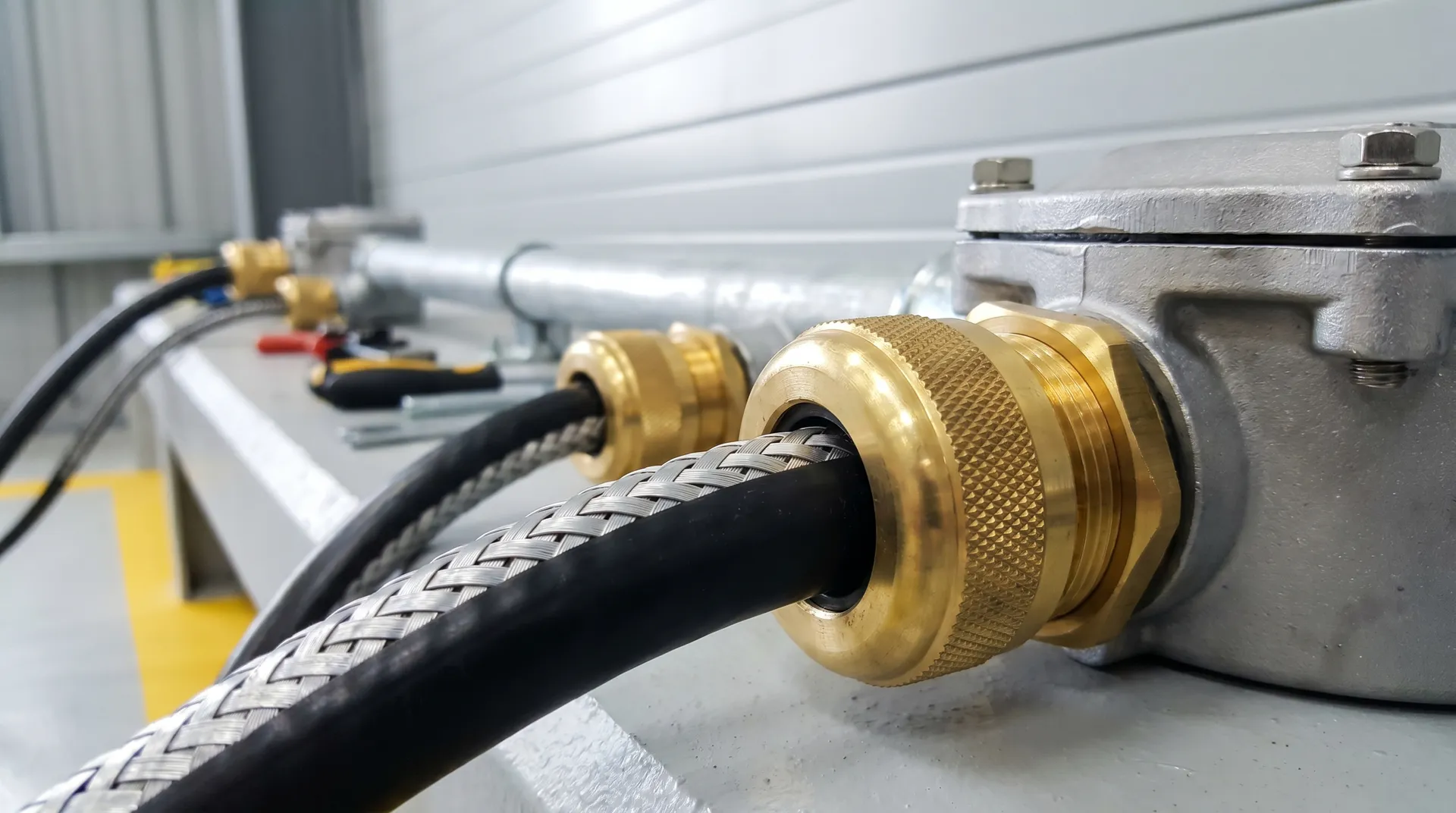
Every penetration through a hazardous-area boundary needs a certified cable gland that maintains the seal of the enclosure. The Canadian standard is CSA C22.2 No. 174, Cables and Cable Glands for Hazardous Locations.
Scope note: No. 174 covers cables generally, and it covers cable glands specifically for Class I Division 1 and Class II Division 1 locations. Division 2 gland suitability isn't set by No. 174; it follows the listing of the enclosure the gland is mounted to (an explosion-proof enclosure installed in a Division 2 area, for example, often still calls for a Division 1-listed gland). Confirm gland suitability against the enclosure's own listing on any Division 2 job rather than assuming a standalone Division 2 rating exists.
Key requirements:
- Match the gland to the cable's outer diameter and armor type
- Match the gland's hazloc rating to the zone: Division 1 glands need explicit No. 174 listing, Division 2 glands follow the enclosure's listing
- Use stainless or brass body for marine / corrosive environments
- Verify ATEX or IECEx alternative certifications where applicable (CAN/CSA C22.2 No. 60079 series accepts these as equivalent)
Cable glands are NOT a place to save money. A non-listed gland on a $600 fixture voids the entire installation's compliance.
Sealing fittings: required at every classified-zone boundary
Separate from cable glands. Sealing fittings (also called "seal-offs") are conduit fittings filled with sealing compound that prevent gas migration through conduit between zones. Required:
- Within 450 mm (about 18 in.) of every Class I Division 1 enclosure per CEC 18-104; 18 in. per NEC 501.15 in the US
- At every penetration of the Division 1 / Division 2 boundary
- Per NEC 501.15 (US) and CEC Section 18 (Canada)
Common mistakes:
- Filling with silicone or putty (non-compliant, must be the listed sealing compound)
- Not damming before pouring (compound runs out)
- Using a seal fitting <5/8" thick (minimum thickness rule)
- Splices inside the seal (forbidden)
Common questions
Can I use US cable types in Canadian installations? Sometimes. TC-ER and similar cables can be acceptable if the manufacturer provides CSA equivalency certification. But Canadian-default types (TECK90 family) are always safer for inspections.
Does TECK90 need conduit? No. TECK90 is acceptable in free-air, cable tray, or raceway. Conduit is optional. That's its main advantage over standard wire that requires conduit everywhere.
What about flexible connections to fixtures? Class I Div 1 requires liquid-tight flexible metal conduit (LFMC) with appropriate connectors, OR extra-hard-usage flexible cord with hazloc-rated cable glands. Not standard NM cable.
Can I splice TECK90 inside a hazloc area? Splices need to be inside a properly listed junction box (Class I Div 1 or Div 2 rated, depending on zone). No tape splices. No twist-on connectors. Listed Polaris-style insulation-piercing connectors with proper covers, inside a listed JB.
Does cable size affect hazloc rating? The rating is on the cable construction, not the conductor size. A #14 AWG TECK90 has the same Class I Div 2 rating as a 500 MCM TECK90. Pick the conductor size for ampacity.
TECK90 vs MC-HL: which one do I actually need for a Division 1 job? Both are certified for Class I Division 1 and Class II Division 1 when installed with the matching listed glands. TECK90-HL generally suits outdoor, wet, direct-burial, and marine runs; MC-HL is generally easier to pull through tight indoor cable trays and conduit runs. Neither is the "wrong" answer to a CSA inspector; the choice comes down to the run, not the rating.
What does "HL" actually stand for? Hazardous Location, not "heavy-loading." The HL suffix marks a cable or gland as tested and certified for Division 1 (or Zone 1) service, on top of whatever base cable type it's added to.
See your industry
This page covers the cable. For where each goes:
- Oil & Gas: TECK90 yards, MC-HL indoors
- Cannabis Extraction: MC-HL or TECK90-HL
- Grain Handling: TECK90 throughout
- Marine & Shipyard: 316 stainless TECK90
- Wastewater: corrosion-grade TECK90 + ACWU90
For what the Class/Division/Group/T-code labels on the fixture itself mean, see our hazardous location classifications guide. For the glands, seals, and conduit that go around the cable, see our installation basics guide.
We carry the cable in stock. Send your line list with fixture quantities and we ship as one package. Or browse Class I Division 2 vapor-tight LED if you're sourcing fixtures at the same time.
Sources: CSA C22.2 No. 174-18, CEC Section 18, CAN/CSA C22.2 No. 60079 series, Eaton hazloc cables/glands white paper (IEEE), Texcan TECK cables.
Need a fixture spec'd to your environment? Send the room dimensions, classification, and ambient, we'll come back same day.
Request Quote