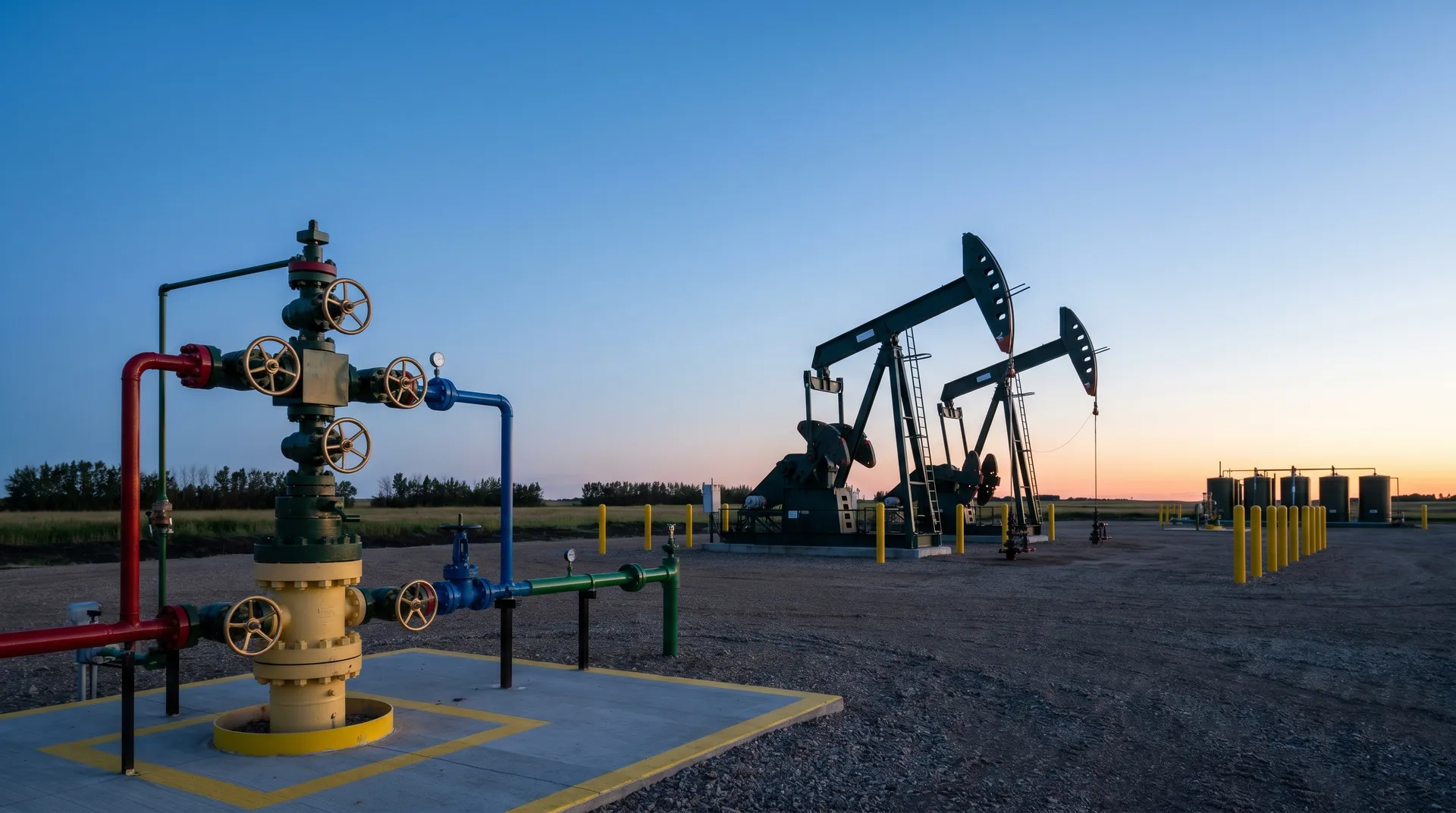
Whether you're operating a wellhead in Lloydminster, a compressor station on the TransCanada line, or a tank farm in Sarnia, the hydrocarbons you're handling are flammable, the zones are classified, and the lighting spec is non-negotiable. Here's the short version of what works on Canadian oil & gas sites and what gets flagged on inspection.
What hazard you're dealing with
Natural gas, methane, propane, butane, and crude oil vapors are all in Group D for classification. Most upstream and midstream sites have a mix of Division 1 zones (immediately around wellheads, pump seals, compressor packing) and Division 2 zones (the broader work area where leaks could happen but don't during normal operation). Tank farms add a third dimension: vapor space inside the tank is Div 1, and the area around vents and openings is Div 2 out to whatever distance the API RP 500 tables call for on your specific classification drawing (it varies with tank type, roof design, dike presence, and ventilation).
How the code classifies typical zones
| Where | Classification | What you need |
|---|---|---|
| Wellhead area (within 3 ft of seal) | Class I, Division 1, Group D | Explosion-proof, T3-T4 |
| Pump skid, compressor enclosure | Class I, Division 1 or 2, Group D | Explosion-proof, T3 |
| Tank farm: inside tank | Class I, Division 1, Group D | (Lighting rarely required inside) |
| Tank farm: near vents and openings | Class I, Division 2, Group D (extent per drawing) | Vapor-tight or Ex-proof |
| Tank farm: yard area | Class I, Division 2 (within 10 ft of tank shell, typical) | Vapor-tight LED |
| Process building interior | Class I, Division 2, Group D | Vapor-tight or Ex-proof, T3 |
API RP 500 + 505 are the working references; CEC Section 18 enforces the equivalent in Canada.
The lighting
- Fixture type: Explosion-proof high bay or area light for Div 1 zones. Class I Div 2 vapor-tight linear or wall pack for perimeter and yard. Cold-weather rated for Western Canada (–40 °C operating).
- T-code: T3 is the practical baseline for propane (autoignition ≈470 °C) and natural gas / methane (autoignition ≈537 °C); T3's 200 °C max surface sits well under both. For H₂S sour-gas service, don't relax the T-code: H₂S has a much lower autoignition point (≈260 °C), so sour sites should hold at T3 or go stricter, never loosen toward T2A. Verify against your site's classification drawing.
- IP rating: IP66 minimum, IP67 for direct-spray exposure on offshore decks.
- Light level: 100–200 lux yard area; 200–300 lux at process equipment; 500 lux at control valves and gauges that need reading.
- CRI: 70+.
- CCT: 5000 K daylight for outdoor; 4000 K inside compressor buildings to reduce glare.
Cables & accessories: we supply these too
Canadian oil & gas sites run on MC-HL or TECK90-HL cable, with CSA C22.2 No. 174 glands at every entry and sealing fittings within 18 inches of every Class I boundary. Cold-weather TECK90 with low-temp PVC jacket for Alberta and Saskatchewan winters. We supply the whole package (fixtures, cable, glands, seal-offs, junction boxes) so your construction crew doesn't lose a day waiting on a missing gland from a separate supplier.
Tank Farm Lighting: Vapor-Tight or Explosion-Proof
Tank farms are the one part of an oil & gas site where the fixture choice splits in two directions. Anything inside the Division 1 envelope (immediately around vents, seals, and openings, per your API RP 500 classification drawing) needs an explosion-proof fixture. Everything in the surrounding Division 2 perimeter, including yard lighting and walkways, can run on vapor-tight LED, which is lighter, cheaper, and easier to mount on tank-farm structures. Or browse Class I Division 2 vapor-tight LED if that's the zone you're speccing.
Quebec rule
Quebec's gas-distribution network (Énergir regulating stations and Gazoduc TQM compressor sites) is inspected by RBQ under Code chapter V. Bill 96 requires French safety labels on imported fixtures. Hydro-Québec's Solutions efficaces can fund LED conversions at gas-handling sites, though most operators here are also CFE-eligible for federal carbon-reduction credits.
Ontario rule
Sarnia's chemical valley, Enbridge compressor stations, and the gas distribution network are inspected by ESA under the OESC. ESA Bulletin 18-1-21 covers classification practice. Save On Energy retrofit incentives apply, and Hydro One has additional industrial programs for large oil & gas customers.
Common questions
What's the difference between API RP 500 and API RP 505? RP 500 uses the Class/Division system (legacy NEC-style). RP 505 uses the Zone system (IECEx-aligned). Most Canadian operators still use Division because that's how CEC Section 18 is written, but new builds increasingly use Zone for international compatibility.
Do I need T2A or T3 for natural gas? Methane, the main component of natural gas, autoignites around 537 °C; propane is lower, around 470 °C. T3 (max 200 °C) clears both with margin, which is why it's the standard. T2A (280 °C max) is technically acceptable for straight natural gas but leaves less margin, and it does not clear sour service, so don't default to it if H₂S is present.
What T-code for sour gas (H₂S) service? H₂S autoignites at a much lower temperature than natural gas or propane, around 260 °C, so the T-code has to tighten rather than relax. T3 (200 °C max) still clears it with a working margin; T2 and T2A do not. Confirm the exact T-code against your site's classification drawing, since sour concentration and any co-located gases can push the requirement to T4 or stricter.
Can I use the same fixture indoor and outdoor? Most Class I Div 1 LEDs are rated for both, but verify the ambient temperature range matches your site (a –20 °C minimum spec doesn't work in Fort McMurray winter).
What about offshore Canadian fixtures (Hibernia, Hebron)? Offshore platforms typically require additional certifications: ABS or DNV marine listing on top of UL 844 / CSA. Verify with the operator before specifying.
Are LED retrofits worth it on remote oil & gas sites? Yes, typically more than at urban sites, because maintenance trips to remote wellheads cost hundreds per service call. LED 5-year payback often shrinks to 2 years when truck-rolls are factored in.
Talk to a specialist
Retrofitting a wellhead, compressor station, or tank farm? Send us your zone classification and quantity, and we quote fixtures, MC-HL/TECK90 cable, glands, and seal-offs as one package. Or browse Class I Division 1 area lights. Browse our full hazardous location lighting catalog for other classifications. Working a chemical-handling site instead? See our chemical plant lighting guide.
Sources: API RP 500, API RP 505, CEC Section 18, NEC Article 500, RBQ Classification, ESA Bulletin 18-1-21, Hydro-Québec, Save On Energy.
Spec'ing a project? We quote the whole package: fixtures, cable, glands, sealing fittings. Same day.