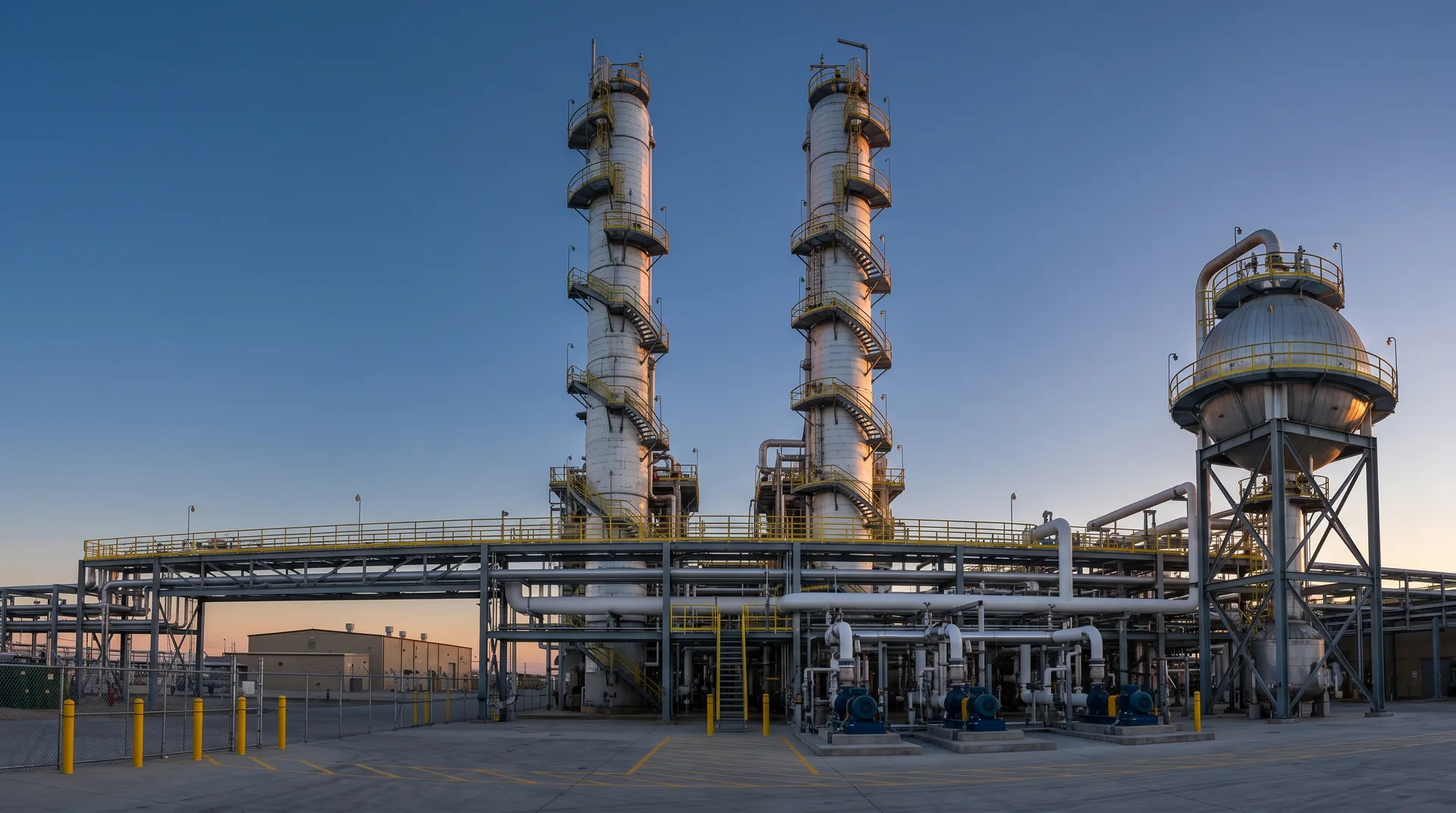
Chemical plants are the trickiest hazloc spec because every chemical has its own gas Group, its own autoignition temp, its own classification rules. Get the Group wrong and a Class I Div 1 fixture rated for natural gas can ignite the hydrogen leak you didn't know you had. Here's how Canadian plants spec lighting that actually matches their process.
What hazard you're dealing with
Chemical plants handle a much wider hazard mix than oil & gas. Group A = acetylene. Group B = hydrogen, ethylene oxide, butadiene. Group C = ethylene, ether, acetaldehyde. Group D = the common stuff (methane, propane, gasoline vapors). Each group needs a fixture rated for that group. A Group D fixture in a hydrogen process is a code violation.
How the code classifies typical zones
| Where | Classification | What you need |
|---|---|---|
| Reactor hall, process building interior | Class I, Division 1 or 2, Group varies | Match Group to chemical handled |
| Solvent storage, drum filling | Class I, Division 1, Group D (mostly) | Explosion-proof, T3-T4 |
| Hydrogen / hydrogenation areas | Class I, Division 1, Group B | Group B-rated, T1-T2 |
| Tank truck loading | Class I, Division 1 (within 3 ft of vent) | Explosion-proof |
| Lab fume hood vicinity | Class I, Division 2 (typically) | Vapor-tight or Ex-proof |
| Outdoor pipe rack | Class I, Division 2, Group varies | Vapor-tight LED |
NFPA 497 lists chemicals by group. Match the fixture to the worst-case chemical in the zone.
The lighting
- Fixture type: Group-rated explosion-proof. Most LEDs are dual-rated A/B/C/D for gases or E/F/G for dusts. Verify the nameplate.
- T-code: T-rating must keep the fixture surface temperature below the autoignition temperature of every chemical that could be in the area. The NEC 80% rule for Class I Division 2 says surface temp must not exceed 80% of the AIT. Hydrogen autoignites at ~500 °C so 80% = 400 °C: T1 (450 °C max) is technically borderline; T2 (300 °C) or T3 (200 °C) is the practical choice. Diethyl ether autoignites at 160 °C so 80% = 128 °C: that means T5 (max 100 °C) is acceptable, T6 (85 °C) is more conservative. Look up each chemical's AIT, apply 80%, pick the highest T-code that stays below.
Group B / Hydrogen-Rated Lighting
Hydrogen shows up in hydrogenation reactors, electrolysis cells, and on-site battery backup rooms within a chemical plant, and it doesn't behave like the Group D solvents most of the rest of the site runs on. Its minimum ignition energy is far lower, so hydrogen zones get their own line item in the spec: Group B-rated explosion-proof fixtures, T-code checked against the 80% margin above rather than assumed. A Group B fixture is also approved for Group C and D atmospheres, so plants often standardize on Group B for any zone that could conceivably see a hydrogen leak, even if the design chemical is something milder. See Battery Room Lighting for the same Group B, hydrogen T-code logic worked through in a single-hazard setting.
- IP rating: IP66 minimum. IP67 in washdown areas.
- Light level: 200 lux process building general; 500 lux at instrument panels, control rooms, sample stations; 1,000 lux at lab benches.
- CRI: 80+ in labs and where chemicals are visually inspected (color change indicators).
- CCT: 4000 K.
Cables & accessories: yes, we supply these too
Chemical plants run MC-HL or TECK90-HL for Class I Div 1; TECK90 for Div 2. CSA C22.2 No. 174 glands matched to the chemical environment. Some need PTFE seals or 316 stainless body. Sealing fittings within 18 inches of every classified-area boundary, every fixture entry, every JB. We ship fixtures, cable, glands, seals, and JBs together so your installation engineer doesn't end up with a Group D gland on a Group B fixture by accident.
Quebec rule
Quebec's chemical industry (Sarnia–Saint-Jean corridor, Bécancour industrial park) is inspected by RBQ under Code de construction chapter V. RBQ requires drawings sealed by a P. Eng. for Class I Division 1 designs. Bill 96 mandates French safety labeling on every fixture sold in Quebec. We handle that. Hydro-Québec's Solutions efficaces covers chemical-process lighting retrofits up to 90% of eligible costs.
Ontario rule
Sarnia chemical valley, Mississauga industrial cluster, and Niagara petrochemical sites are inspected by ESA under the OESC. ESA Bulletin 18-1-21 walks through classification practice, and ESA accepts P. Eng.-sealed drawings as evidence of compliant design. Save On Energy's Retrofit Program covers up to 50% of project cost.
Common questions
My process uses ethanol. Group D or Group C? Group D. Ethanol vapors are in Group D. Don't confuse with Group C "diethyl ether" which is a different solvent.
Can a Group B fixture work in a Group D area? Yes. Group B fixtures are always acceptable in Group C and D areas (it's a stricter rating). Reverse is not true.
What does T6 actually mean for a chemical plant? T6 = max surface temperature 85 °C. Required when handling chemicals like carbon disulfide (autoignition 90 °C: even T6 has only 5 °C margin). For diethyl ether (autoignition 160 °C), T5 (100 °C) is acceptable per the NEC 80% rule; T6 is more conservative and what cautious specifiers choose. Most LEDs hit T4 or T5 easily; T6 fixtures are larger, heatsink-heavy, and cost more.
Do I need different fixtures for different rooms in the same plant? Yes. Match each room's classification, group, and T-code. Plants typically standardize on Group B-rated fixtures for hydrogen-handling areas and Group D for solvent areas. Don't mix.
How does a P. Eng. sign off on hazloc lighting? The P. Eng. seals the area-classification drawings and the electrical drawings showing fixture selection per zone. RBQ and ESA accept these as evidence. We provide spec sheets and certifications to support the engineer's seal package.
Related reading
- Hazardous Location Classifications: what Class, Division, Group, and T-code mean on a fixture nameplate.
- Battery Room Lighting: Group B hydrogen fixture selection in a single-hazard setting.
- Cannabis Extraction Lighting: Group D solvent fixture selection in a single-hazard setting.
- Aircraft Hangar Lighting: Group D Jet A fixture selection in a single-hazard setting.
Talk to a specialist
Designing a chemical plant lighting package? Send us your area-classification drawings. We quote fixtures, MC-HL/TECK90, glands, and JBs matched to each Group. Or browse Class I Division 1 fixtures. Browse our full hazardous lighting catalog for other classifications. NemaLED is a hazardous location lighting supplier in Canada shipping certified fixtures nationwide.
Sources: NFPA 497, NFPA 70 Article 500-505, CEC Section 18, RBQ Classification, ESA Bulletin 18-1-21, Hydro-Québec, Save On Energy.
Spec'ing a project? We quote the whole package: fixtures, cable, glands, sealing fittings. Same day.