Pharma sites have two competing demands: GMP-compliant clean rooms (smooth, washable, particle-controlled) and hazardous solvent areas (explosion-proof, T-rated, leak-tolerant). Often in the same building. Here's how Canadian pharma operators spec lighting that satisfies Health Canada AND CEC Section 18 simultaneously.
What hazard you're dealing with
Pharma manufacturing uses ethanol, methanol, isopropyl alcohol, acetone, hexane, and ether; most are flammable Group C or D solvents. Solvent storage rooms, dispensing booths, and bulk transfer areas are typically Class I, Division 1 or 2. Adjacent clean rooms are unclassified but have GMP cleanliness requirements that drive fixture surface and material choices. The interface between hazardous and GMP zones is where most spec mistakes happen.
How the code classifies typical zones
| Where | Classification | What you need |
|---|---|---|
| Solvent storage room | Class I, Division 1 or 2, Group D | Explosion-proof, smooth body |
| Solvent dispensing booth | Class I, Division 1, Group D | Explosion-proof, T3-T4 |
| Reactor / mixing area (with solvent) | Class I, Division 1 or 2, Group C/D | Group-matched, T-rated |
| Clean room (ISO 7 / 8 typical) | Unclassified, GMP-controlled | Sealed cleanroom LED |
| Lab: chemistry analytical | Class I, Division 2 (near fume hoods) | Vapor-tight or Ex-proof |
| Warehouse for finished goods | Unclassified | Standard industrial LED |
The lighting
- Fixture type: Class I Div 1 explosion-proof for solvent rooms; sealed cleanroom-rated LED for GMP zones (smooth lens, no horizontal ledges, ingress-protected for wash-down with quaternary disinfectants).
- T-code: T3 minimum for ethanol/IPA/acetone; T4 if processing ether or aldehydes.
- IP rating: IP66 hazardous zones; IP65+ clean rooms.
- Light level: 500 lux dispensing and inspection; 750 lux QC labs and visual-inspection benches; 200 lux warehouse aisles.
- CRI: 90+ in QC labs and visual inspection. Color change indicators in pharmacopeial tests need true color rendering.
- CCT: 4000–5000 K. Cleanrooms often standardize on 5000 K for visual fatigue reasons.
- Surface finish: Stainless steel or smooth painted aluminum for cleanrooms, not powder coat with texture (can't be wiped to GMP standard).
GMP Cleanroom Lighting
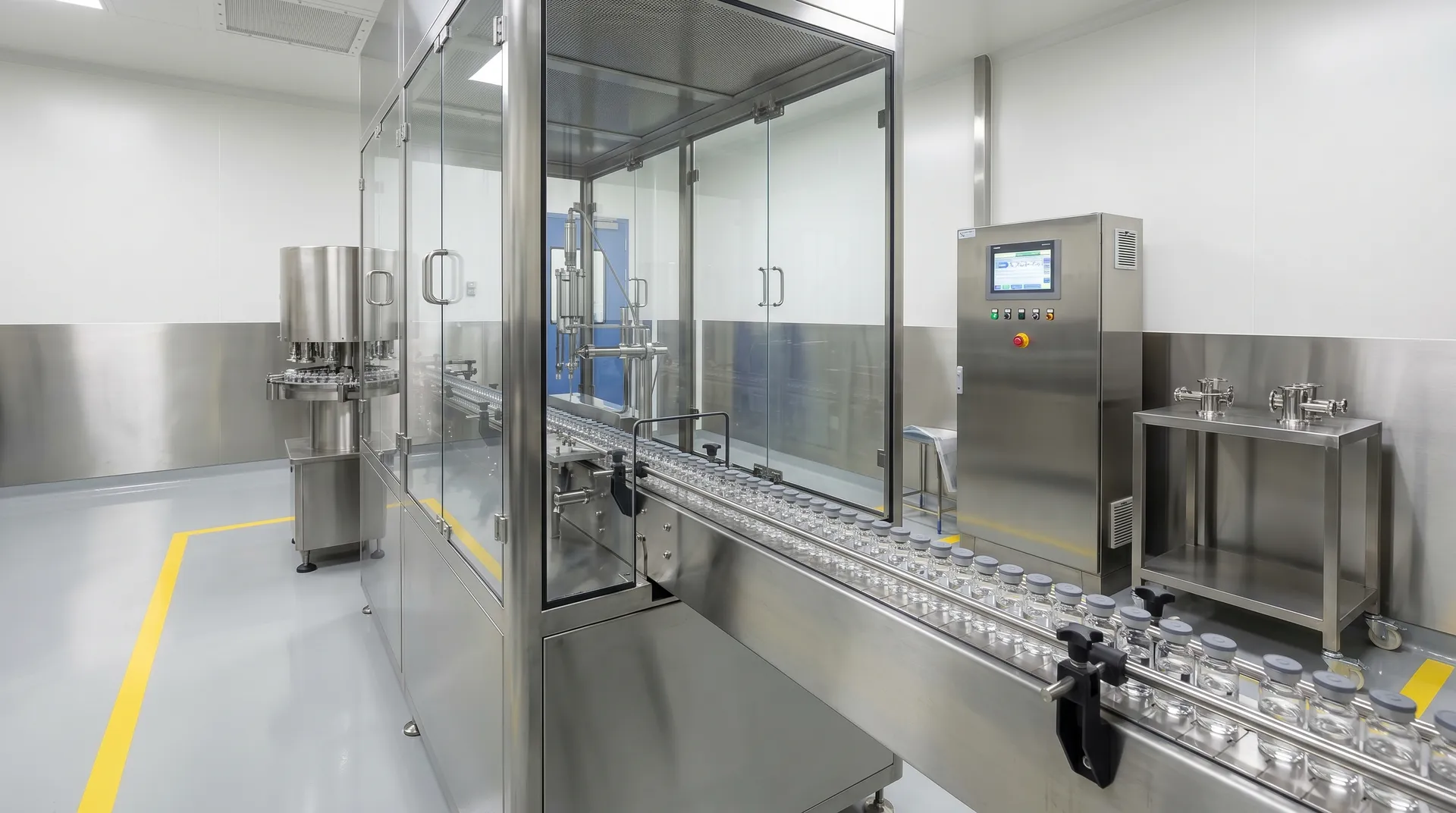
Cleanrooms sit right next to the hazardous solvent rooms in most pharma layouts, but they run on a completely different spec. GMP cleanroom LEDs need a smooth, wipeable lens and housing with no horizontal ledges to trap particulate, an ingress rating that survives quaternary-disinfectant wash-down, and enough CRI for visual inspection work, but they don't need explosion-proof housings unless the room itself carries a hazardous classification. Mixing the two families up is one of the most common spec mistakes on a pharma build: a cleanroom-rated fixture in the solvent room fails inspection, and an explosion-proof fixture in the cleanroom fails the GMP wipeability requirement.
The same Group D solvents (ethanol, IPA, acetone) show up in other spray and coating environments too. See our Paint Booth Lighting guide if your facility also runs a coating or finishing line.
Cables & accessories: we supply these too
Solvent rooms run MC-HL or TECK90-HL with CSA C22.2 No. 174 glands. Cleanrooms run sealed conduit (EMT or surface raceway) with stainless or polymer JBs that wipe to GMP standard. The interface penetrations between hazardous and clean zones need sealing fittings on both sides. We supply fixtures, cable, glands, and GMP-acceptable JBs as one package; pharma contractors often miss the surface-finish requirement on clean-side JBs and have to swap them mid-build.
Quebec rule
Quebec has a major pharma cluster (Laval, Boucherville, Montreal West Island, home to several multinational drug manufacturers). RBQ inspects under Code de construction chapter V. Bill 96 requires French on safety labels and operator-facing signage. Health Canada's GMP audit can also flag electrical practices if they don't match validated drawings. Hydro-Québec's Solutions efficaces covers LED retrofits at pharma facilities up to 90% of eligible costs.
Ontario rule
Ontario pharma cluster runs through Mississauga, Brampton, Markham. ESA inspects under the OESC. ESA Bulletin 18-1-21 covers Class I classification. Save On Energy covers up to 50% of LED retrofit project costs. Coordinate any retrofit with your facility's GMP validation team; replaced fixtures need a deviation report.
Common questions
Can I use the same fixture in solvent storage and the adjacent clean room? No. Solvent storage = Class I Div 1 explosion-proof. Clean room = GMP cleanroom-rated. Different fixture families, different surface requirements.
Do GMP cleanroom LEDs need explosion-proof rating? Only if the clean room has a hazardous classification (most don't, since solvents are kept in adjacent storage areas). A typical Class 100,000 / ISO 8 cleanroom with no solvent presence is unclassified.
My API plant runs a Group C process. T-code? Group C covers ethers, aldehydes, ethylene. Diethyl ether autoignites at 160 °C, and the code baseline is straightforward: the fixture's marked surface temperature has to stay below that. T4 (135 °C max) already clears it. Some AHJs apply a more conservative guideline of staying under 80% of the autoignition temperature (a 128 °C ceiling for ether); under that stricter reading, T4A (120 °C max) or T5 (100 °C max) adds extra margin. T6 (85 °C max) is available but over-spec for this solvent. Confirm the exact T-code against your classification drawing.
Are LED retrofits a GMP-validated change? Yes. Any electrical fixture swap is a controlled change under Health Canada GMP. Coordinate with QA early (drawings, validation impact assessment, change order) before procurement starts.
What about the warehouse area? Bulk pharma warehouses (finished goods, packaging materials) are usually unclassified and can use standard industrial LED high bay. Check if any sub-zones (solvent transfer, retain samples) have hazardous classification.
What CRI for pharmacopeial color checks? Pharmacopeial color-comparison tests rely on an inspector matching a sample's true color against a reference standard, so the lighting needs a high color-rendering index, typically 90+ CRI, at the QC bench where those checks happen. Confirm the exact CRI and viewing-condition requirement against your lab's validated SOP, since some pharmacopeial methods specify a particular illuminant.
Talk to a specialist
Pharma plant retrofit or new build? Send us your zone classifications and GMP class, and we quote hazardous-area fixtures, cleanroom LEDs, and accessories matched to each space. Or browse Class I Division 1 LED.
Sources: NFPA 30, NFPA 497, Health Canada GMP guidance, RBQ Classification, ESA Bulletin 18-1-21, Hydro-Québec, Save On Energy.
Spec'ing a project? We quote the whole package: fixtures, cable, glands, sealing fittings. Same day.