
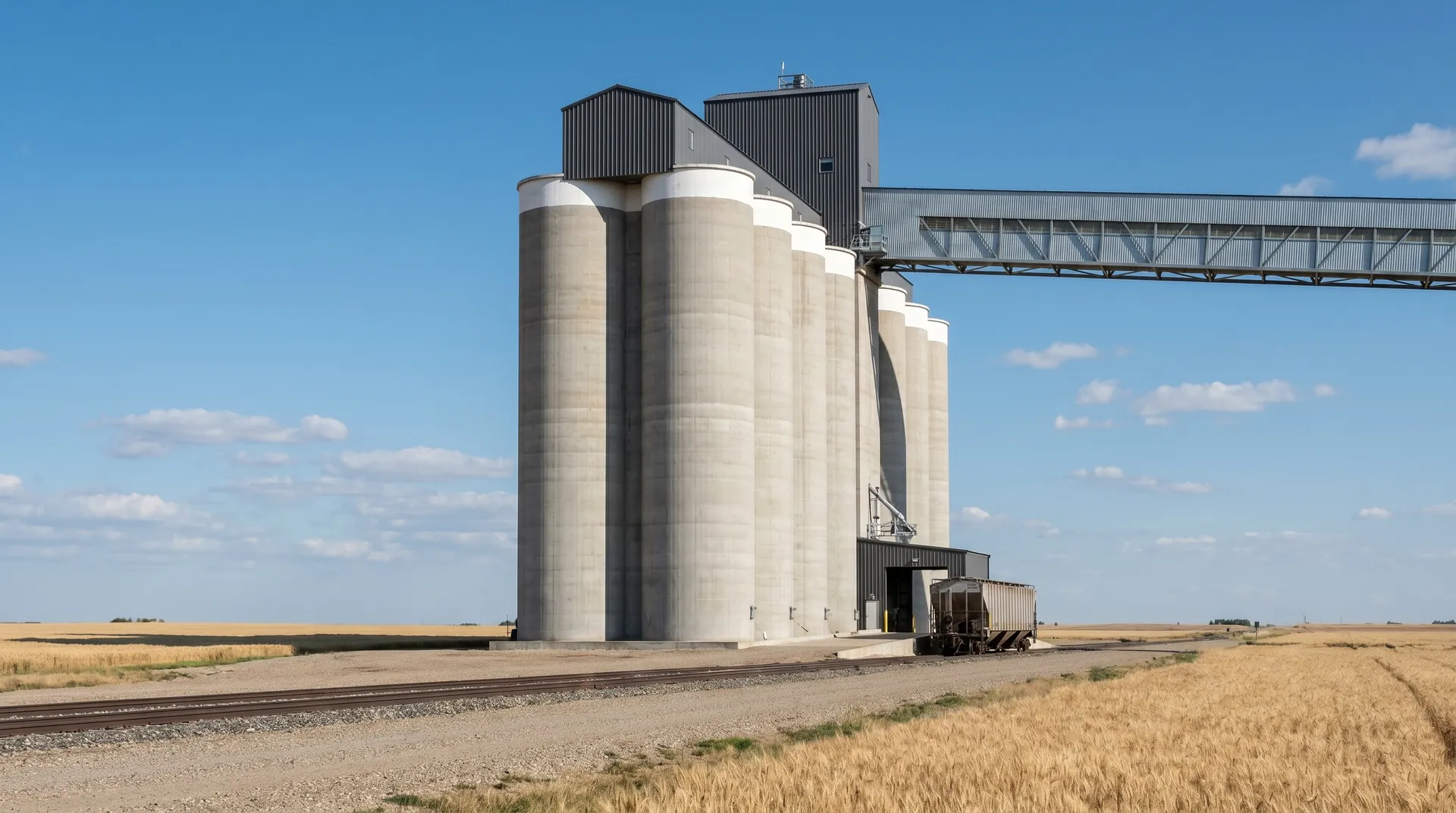
You operate a grain elevator, feed mill, or silo complex. Wheat, corn, oats, and soy all generate combustible dust that hangs in the air during loading and settles on every horizontal surface in between. The code calls dust-laden zones Class II, Division 1 and accumulation zones Class II, Division 2. Here's what fixture and cable spec actually keeps your insurance valid.
What hazard you're dealing with
Grain dust is finer than you think. A dust cloud at 30 g/m³ is enough to ignite, and that concentration is barely visible. A static spark, a hot surface, or a bearing seizing on a conveyor can each light off a primary explosion that knocks accumulated dust off ledges and rafters into a secondary explosion that levels the building. The 1977 Westwego elevator disaster killed 36 people exactly this way. Code is built around that risk.
How the code classifies your facility
| Where | Classification | What you need |
|---|---|---|
| Inside elevator legs, conveyor heads, dust collectors | Class II, Division 1, Group G (grain dust) | Dust-ignition-proof, UL 1203 |
| Headhouse interior, scale floor, tunnel | Class II, Division 2, Group G | Dust-tight, UL 1203 or sealed UL 844 |
| Outside on grounds | Unclassified (or Div 2 within 3 ft of openings) | Standard outdoor LED |
Group G covers grain, flour, and starch dusts. NFPA 61 (Standard for Agricultural and Food Processing Facilities) sets the practical zone definitions. See our Class II Division 1 fixtures for the elevator-leg and dust-collector zones.
Choosing the right T-code for grain dust
The T-code on a fixture's nameplate sets its maximum surface temperature under rated operating conditions, and that number has to stay below the ignition temperature of the dust around it, with margin. Grain dust ignition depends on whether it's airborne or settled: a dust cloud typically ignites in roughly the 400-430 °C range, while a settled layer can smolder at well under 300 °C, because heat concentrates in undisturbed dust in a way a moving cloud doesn't. That's why Class II fixtures for grain handling are commonly specified at T3 (200 °C max surface) or better; T4 (135 °C) gives more margin below the layer-ignition range and is the more common spec for elevator legs and headhouses.
Don't treat either number as a substitute for site-specific data. Confirm the actual ignition temperature for your grain and process against your facility's dust hazard analysis, and match the fixture's nameplate T-code to that figure per NFPA 61, not to a rule of thumb.
The lighting
- Fixture type: Dust-ignition-proof LED high bay or vapor-tight linear, fully sealed gasketed body. Smooth top so dust doesn't accumulate on the housing.
- T-code: T3 or T3A minimum, T4 preferred. See "Choosing the right T-code for grain dust" above for how to confirm the exact figure for your facility.
- IP rating: IP66 minimum. IP66 + smooth body = self-cleaning under air movement.
- Light level: 200 lux on the floor of headhouse and tunnels. 500 lux at scale stations and inspection points.
- CRI: 70+ is fine. Grain inspection is done in dedicated lighting booths, not under general lights.
- CCT: 4000–5000 K.
- Mounting: Pendant or surface, no recessed (recess pockets accumulate dust). Low-profile housings are best.
Cables & accessories (yes, we supply these too)
Inside Class II Div 1 zones, TECK90 with sealed glands is standard practice in Canadian elevators. CSA C22.2 No. 174 cable glands with dust-tight gaskets. All conduit penetrations need sealing fittings to keep dust out of the JB. We supply the cable, glands, seal-offs, and dust-tight junction boxes alongside the fixtures so your contractor isn't sourcing five things from five vendors.
Quebec rule
Saint-Lawrence transit elevators (Sorel, Quebec City, Trois-Rivières) are inspected by RBQ under Code de construction chapter V. Bill 96 requires French safety labels on every fixture sold for QC sites. Hydro-Québec's Solutions efficaces program's Medium and Large Business component covers grain-handling LED retrofits up to 75% of eligible costs (program terms as of September 2026); agricultural-market operations may instead qualify under the program's separate Farming Component, whose percentage varies by measure, so check current terms for your account type.
Ontario rule
Thunder Bay, Hamilton, and the Sarnia grain corridor are inspected by ESA under the OESC. ESA Bulletin 18-1-21 walks through Class II classification practice. Save On Energy's Retrofit Program covers up to 50% of LED upgrade costs, and Ontario operators of agricultural facilities also have access to enhanced incentives through the Agricultural Energy Program.
Common questions
Is dust-tight the same as dust-ignition-proof? No, and the two labels get swapped often. NEMA Type 9 is itself the dust-ignition-proof classification, tested to UL 1203: it excludes dust and prevents internal arcs, sparks, or heat from igniting dust outside the enclosure. A plain dust-tight enclosure keeps dust out under normal conditions but isn't evaluated for that ignition-proof performance. Class II Division 1 needs the NEMA 9 / dust-ignition-proof rating; Class II Division 2, where ignitable concentrations aren't expected during normal operation, can generally use dust-tight construction. Always check the fixture nameplate for the specific rating and division it covers.
What T-code do I need for grain dust? There's no single number that covers every grain and every facility. As a starting point, Class II fixtures for grain dust are commonly specified at T3 or T4, since both sit below the typical cloud-ignition range for wheat and similar grains, with T4 giving more margin below the lower layer-ignition range. But "commonly specified" isn't the same as "required for your site": confirm the actual ignition temperature for your specific product and process against your facility's dust hazard analysis, and match the fixture's nameplate T-code to that number rather than to a generic guide like this one.
Can I use a Class I fixture in a Class II area? Sometimes: many Class I Div 1 explosion-proof fixtures are also UL-listed for Class II Div 1. Check the fixture nameplate for the dual rating. Don't assume.
How often should I clean grain dust off my fixtures? The fixture should be self-cleaning by design (smooth body, IP66). But operators should still wipe accumulated dust monthly. Build it into your housekeeping plan; NFPA 61 expects a written program.
Do I need explosion vents in my elevator legs even with proper lighting? Yes. Lighting is one ignition source; bearings, static, and motors are others. Explosion vents are about containing a primary blast, separate from electrical safety.
What's the difference between Group F and Group G? Group F = carbonaceous dusts like coal, charcoal, soot. Group G = grain, flour, starch. Most grain handling needs Group G; if you process oilseed (canola, sunflower) where there's residual oil dust, Group F may also apply.
Talk to a specialist
Retrofitting a grain elevator or silo? Send us your facility layout and we quote fixtures, TECK90 cable, glands, and dust-tight JBs as one package. Or browse Class II Division 1 fixtures.
Sources: NFPA 61, NFPA 499, RBQ Classification, ESA Bulletin 18-1-21, Hydro-Québec Farming Component, Save On Energy, CEC Section 18.
Spec'ing a project? We quote the whole package: fixtures, cable, glands, sealing fittings. Same day.