
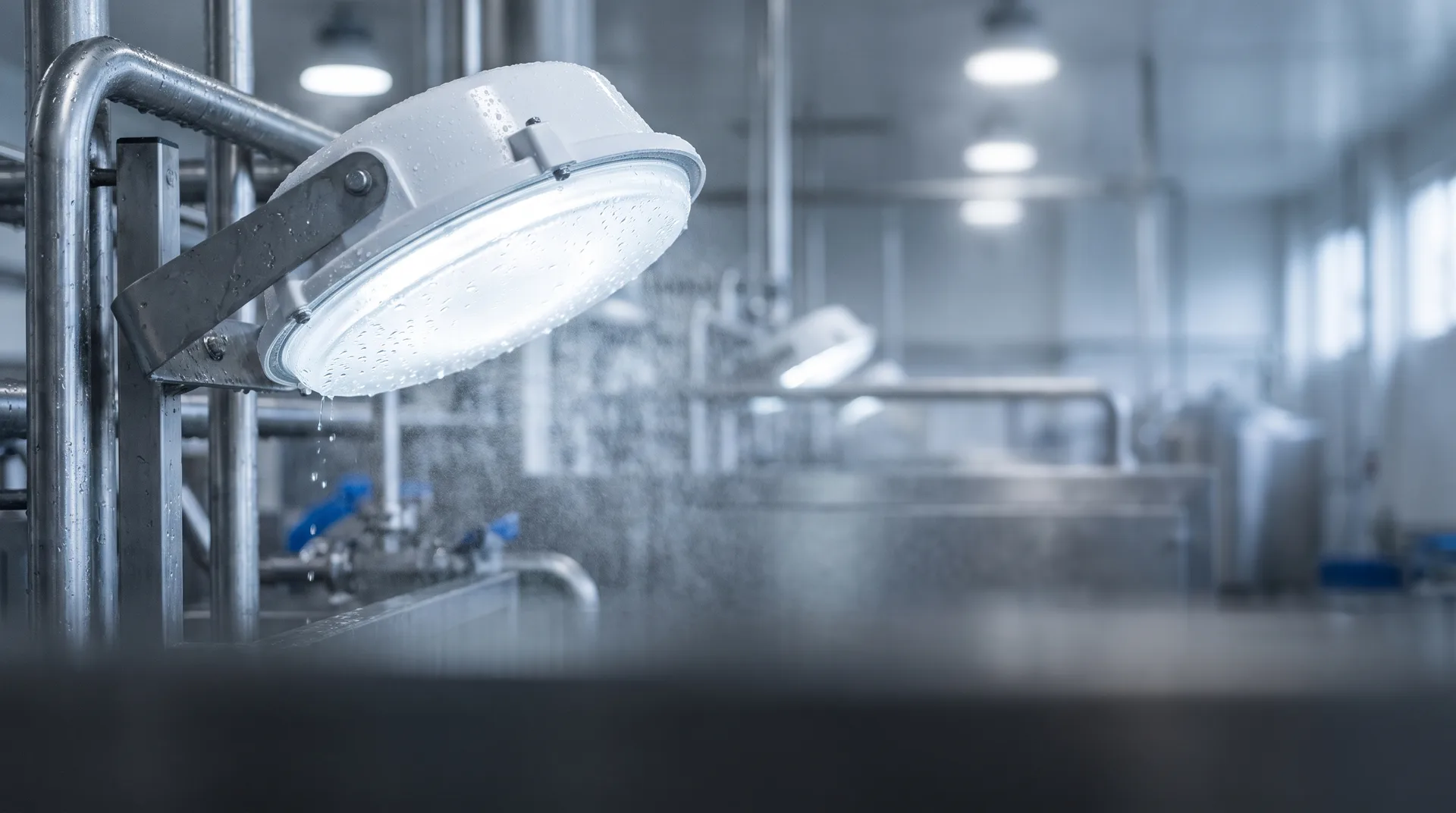
IP67 and IP69K are both "sealed against dust and water" ratings, but they test two different threats. IP67 proves a fixture survives temporary submersion in up to 1 meter of water for 30 minutes. IP69K proves it survives close-range, high-pressure, high-temperature spray, the kind of wash-down and steam cleaning used daily in food, beverage, and dairy plants. A fixture can pass IP67 and fail IP69K, because submersion and pressure-washing stress a seal in completely different ways. If your fixture gets pressure-washed or steam-cleaned on a schedule, IP69K is the rating that matters. IP67 is not a substitute.
Reading an IP code
IP ratings (IEC 60529) use two digits. The first covers solid/dust ingress, the second covers water.
| Digit position | What it measures | Top rating |
|---|---|---|
| First digit (dust) | Protection against solid objects and dust | 6 = fully dust-tight |
| Second digit (water) | Protection against water ingress | Varies by test, see below |
IP69K's "K" isn't a number. It's a separate test standard (originally German DIN 40050-9, now folded into ISO 20653) layered on top of a 6X dust-tight base rating. It doesn't replace the second digit; it adds a harsher water test most IP-rated products never see.
IP66 vs IP67 vs IP69K: what each one actually proves
| Rating | Test | Proves the fixture survives |
|---|---|---|
| IP66 | Powerful water jets (12.5 mm nozzle, 100 L/min, from 2.5–3 m) from any direction for 3 minutes | Heavy rain, hose-down splash |
| IP67 | Full submersion in 15 cm–1 m of water for 30 minutes | Temporary flooding, submersion |
| IP69K | Close-range (100–150 mm), high-pressure, high-temperature spray from four fixed angles | Daily high-pressure, high-temperature wash-down and steam cleaning |
Notice IP67 and IP69K test different physics. IP67 is about depth and duration of static water. IP69K is about pressure and heat at close range, the exact conditions of a CIP (clean-in-place) hose-down or a foam-cannon cycle in a meat, dairy, or bottling plant.
How the IP69K test actually works
The IP69K test procedure specifies:
- Water pressure: 80–100 bar (roughly 1,160–1,450 psi)
- Water temperature: 80°C
- Spray distance: 100–150 mm from the fixture
- Flow rate: approximately 14–16 L/min
- Test angles: the nozzle is aimed at four fixed angles (0°, 30°, 60°, and 90°) for 30 seconds each, rotating the fixture as needed to cover it fully
- Total exposure: roughly 2 minutes per test position across the four angles
That's a materially harsher test than a garden hose or even a commercial pressure washer at typical settings, which is exactly the point. It mirrors the sanitation-cycle equipment food and beverage plants actually run every shift.
When IP67 is enough, and when you need IP69K
- IP67 (or IP66) is usually fine for outdoor area lighting, occasional splash zones, non-food warehouse space, and anywhere the fixture might get rained on or hosed off casually.
- IP69K is the standard to spec for direct wash-down and CIP corridors: production floors, packaging lines, dairy and meat processing halls, bottling rooms, and anywhere a hose, foam cannon, or steam wand reaches on a regular sanitation schedule.
Don't over-spec the whole plant to IP69K if only the production floor gets pressure-washed, since dry storage and office space typically don't need it. See our washdown lighting spec guide for how to zone a facility correctly, and our Food Processing IP69K line or industrial food-processing category for fixtures built to this exact test.
Common questions
Is a higher IP69K number always better than IP67? They're not on the same scale, so "higher" doesn't quite apply. IP69K adds a harsher, different test on top of a 6X dust-tight base rating. A fixture can be IP69K and NOT independently IP67-tested (though in practice most IP69K fixtures also pass IP67, since submersion is an easier bar than a hot, high-pressure spray).
Can I assume a product is IP69K just because the listing says "waterproof"? No. "Waterproof" isn't a defined IP rating. Always ask for the specific IP code and, ideally, the test report or certificate, since some listings use IP69K as a marketing term without a documented test behind it.
What's the difference between IP69 and IP69K? IP69 and IP69K are tested against the same close-range, high-pressure, high-temperature spray procedure. IP69K additionally requires the 6X dust-tight base rating, so in practice the two are treated as equivalent for most industrial products, and IP69K is the designation more commonly quoted on spec sheets.
Does IP69K cover chemical or caustic washdown, or only water? The IP69K test itself uses water, not cleaning chemicals or caustic agents. Whether a fixture holds up to a chemical or caustic wash cycle depends on the housing and gasket material's chemical compatibility, which is a separate spec from the IP rating. Check the material compatibility for the specific cleaning agents your sanitation program uses.
Does IP69K protection mean the fixture is also NSF or food-safe? No. IP69K is purely an ingress-protection rating. NSF or 3-A listing is a separate certification covering materials, surface finish, and food-contact safety. A fixture can be IP69K without being NSF-listed, and you typically need both for direct food-contact zones.
Is IP69K the same as NEMA 4X? No, though they're often paired. IP69K is a pressure- and temperature-specific spray test. NEMA 4X is a North American enclosure standard that also covers corrosion resistance and windblown dust, tested differently. For food wash-down, look for both ratings together rather than treating either as a full substitute for the other.
What ambient temperature do IP69K fixtures need to survive, separate from the spray test? Ingress protection and ambient operating temperature are two different specs. A fixture's IP69K rating says nothing about how hot the surrounding air can get during normal operation. Check the ambient temperature rating on the spec sheet separately, especially near ovens, fryers, or pasteurizers.
Sources: IEC 60529 (Degrees of protection provided by enclosures, IP Code), ISO 20653 / DIN 40050-9 (Road vehicles, degrees of protection, protection of electrical equipment against foreign objects, water and dust).
Need a fixture spec'd to your environment? Send the room dimensions, classification, and ambient, we'll come back same day.
Request Quote