
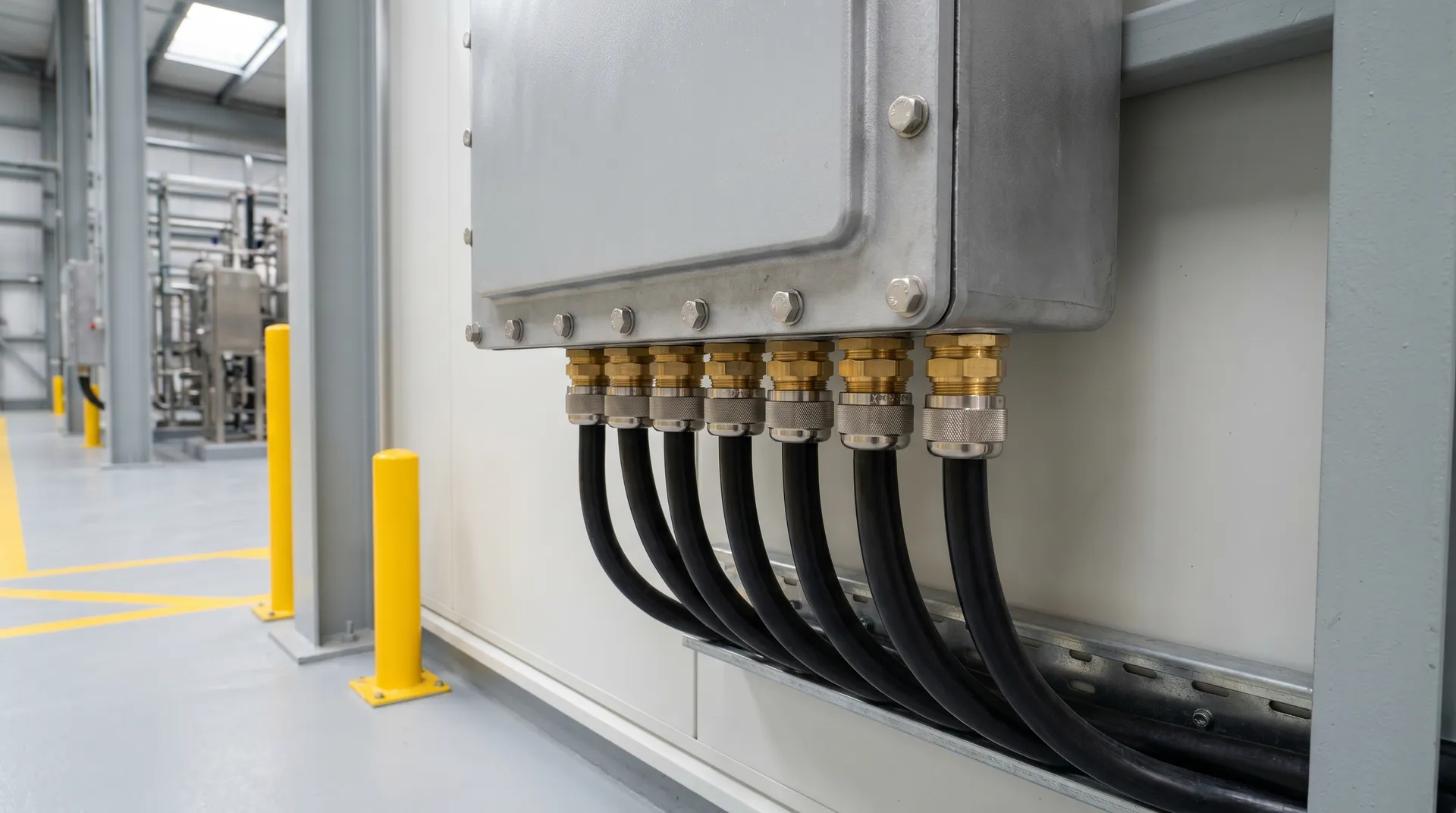
A perfectly spec'd Class I Division 1 LED fixture means nothing if the conduit seal is missing or the cable gland is the wrong type. Most hazloc inspection failures aren't about the fixture; they're about what's around it. Here's the practical install reference for Canadian electricians.
Seal off fitting requirements
Sealing fittings (a.k.a. seal-offs, conduit seals) are conduit fittings filled with listed sealing compound that prevents flammable gas from migrating through conduit between zones. Without a seal, a leak in a Class I area can travel through the conduit into a non-classified room and ignite there.
Where they're required (per CEC 18-104 + NEC 501.15):
- Within 450 mm (about 18 in.) of every Class I Division 1 enclosure per CEC; 18 in. per NEC 501.15 in the US
- At every penetration of the Division 1 / Division 2 boundary
- At every penetration of the classified / unclassified boundary for ¾" or larger conduit
- Where conduit enters/exits enclosures rated Division 1 with arcing parts
The 5 most common mistakes that fail inspection:
- Filling with silicone or putty. Non-compliant. Use only the listed sealing compound supplied with the fitting.
- No damming before pour. Compound runs out, leaves gap. Use the supplied damming fiber or rope.
- Too thin. Minimum 5/8 inch thick AND not less than the trade size of the conduit. A ¾" conduit needs at least ¾" of compound.
- Splices inside the seal. Forbidden. The seal must contain only conductors, no splices, no taps.
- Inaccessible location. Sealing fittings must be installed in accessible locations for future inspection. Buried inside a wall? Re-do.
Cable glands: the cable equivalent
When you use armored cable (TECK90, MC-HL, ACWU90) instead of conduit, cable glands seal the cable entry into hazardous-area enclosures. Canadian standard: CSA C22.2 No. 174.
Scope note: No. 174 covers cable glands specifically for Class I Division 1 and Class II Division 1 locations. It doesn't cover Division 2 glands directly; a Division 2 gland's suitability follows the listing of the enclosure it's mounted to, not a standalone No. 174 rating. In practice this often means a Division 2 enclosure calls for a gland listed to the Division 1 standard anyway, so check the enclosure manufacturer's instructions rather than assume a lighter-rated gland is acceptable.
What to verify on every gland:
- Match cable outer diameter exactly (use manufacturer's gland sizing chart)
- Match armor type (interlocked aluminum vs continuous metal vs braided)
- Match hazloc rating: Division 1 glands need explicit No. 174 listing, Division 2 glands follow the enclosure's listing
- Match environment (stainless body for marine / corrosive; brass for general industrial)
- CSA certification visible on the gland
Common mistakes:
- Using a Div 2-rated gland in a Div 1 enclosure (under-rated)
- Wrong sizing: gland too large lets the seal slip, too small crushes the cable
- Mixing manufacturer parts (gland body from one maker, sealing ring from another voids the listing)
- Zinc-plated gland in chlorine wastewater zone (corrodes within months, needs stainless or polymer)
Junction boxes: listed for the zone, not just the cover
Every junction in a hazardous area needs a JB listed for that classification. A standard NEMA 12 box doesn't cut it for Class I Div 1 even if you bolt the cover tight.
For Class I Division 1: Cast metal explosion-proof JB with threaded hubs (no knockouts), gasketed cover with multiple bolts, listed for the relevant Group (B for hydrogen, D for general).
For Class I Division 2: Heavy-duty NEMA 4 with vapor-tight gasket. Some installations accept properly sealed standard industrial JBs in Div 2; verify with your AHJ.
For Class II Division 1 or 2: Dust-tight or dust-ignition-proof JB. Smooth body (no horizontal ledges where dust accumulates).
For corrosive environments: 316 stainless steel or fiberglass-reinforced polyester (FRP). Aluminum corrodes in salt or chlorine air.
Conduit: when and what type
In Canada, TECK90 and TECK90-HL eliminate most conduit needs for industrial installations because they can run in free-air, cable tray, or raceway. But conduit is still needed for:
- Flexible connections to fixtures: liquid-tight flexible metal conduit (LFMC) with hazloc-rated connectors
- Single-circuit branches in unclassified areas connecting to standard wire types
- Building service entrances where cable must transition to wire-in-pipe
Conduit types accepted in CEC Section 18:
- Threaded rigid metal conduit (RMC): Class I Div 1
- Threaded intermediate metal conduit (IMC): Class I Div 1
- Type MI (mineral insulated) cable: Class I Div 1
- EMT: only in specific Class I Div 2 limited applications
- LFMC: flexible connections only, not main runs
Bonding and grounding: don't forget
Hazardous-area bonding requirements are stricter than general industrial. CEC Section 10 + Section 18 together require:
- Continuous bonding throughout the hazardous-area system
- Bonding bushings or threaded hubs at every conduit transition
- Equipment grounding conductor in every cable assembly
- Verification that the entire installation maintains an unbroken grounding path
A loose ground at one fitting compromises the safety of the entire run.
The pre-inspection checklist
Before you call ESA or notify RBQ, walk through:
- Every conduit penetration into Class I Div 1 enclosure has a sealing fitting within 450 mm (18")
- Every Division 1 / Division 2 boundary has a sealing fitting
- All sealing fittings are filled with listed compound (not silicone / putty)
- All cable glands match cable, armor type, and zone rating
- All cable glands carry CSA C22.2 No. 174 listing (Division 1) or match the enclosure's own listing (Division 2)
- All junction boxes are listed for their zone
- All flexible connections use LFMC with listed connectors
- Bonding is continuous throughout the system
- All fixture nameplates match the area classification
- T-codes match or exceed the worst-case chemical autoignition margin
- No splices inside any seal-off
- All listed equipment markings are visible and legible
If anything fails this checklist, fix before the inspector arrives.
Common questions
My existing install uses silicone-filled seals from years ago. Grandfathered? No. If the inspector flags it, you fix it. Hazardous-area code is enforced retroactively when work is done in the area.
Can I splice in a junction box adjacent to a sealing fitting? Yes. Splices are fine in a properly listed JB. The forbidden splice is inside the seal-off itself.
Does TECK90 still need conduit if I run it in cable tray? No. TECK90 in tray is the standard Canadian industrial install. Cable tray + TECK90 + cable glands at every classified-zone enclosure entry covers Div 2 fully.
Who can install hazardous-area lighting? Quebec: licensed master electrician (CMEQ-member). Ontario: Licensed Electrical Contractor (LEC) with ESA notification. Both provinces require a P. Eng. for Division 1 design seals on any non-trivial install.
How long does a typical hazloc inspection take? Quebec: RBQ often does compliance audits, not pre-inspections; timing could be days, weeks, or never depending on the project. Ontario: ESA inspects within 5–10 business days of notification for most jobs; staged inspections on large projects.
See your industry
This page covers the install. For where each install method applies:
- Paint Booth: Class I Div 1 inside, sealing fittings every 450 mm (18") + at booth penetrations
- Cannabis Extraction: Class I Div 1 throughout, MC-HL with C22.2 No. 174 glands
- Oil & Gas: TECK90-HL with sealed glands at every classified penetration
- Wastewater: Stainless or FRP glands + JBs in chemical zones
For the cable types that pair with these glands, see our Canadian cables guide. For what the Class/Division/Group/T-code labels on the fixture mean, see our hazardous location classifications guide. For how Quebec and Ontario inspection processes differ once the install is done, see our Quebec vs Ontario rules guide.
We supply the sealing fittings, glands, and JBs alongside the fixtures so your contractor doesn't run out of parts on install day. Or browse Class I Division 1 fixtures if you're sourcing the lighting at the same time.
Sources: CEC Section 18, NEC 501.15, CSA C22.2 No. 174-18, ESA Bulletin 18-1-21, RBQ, IAEI Magazine (sealing in Class I), EC&M magazine, Eaton hazardous installation white papers.
Need a fixture spec'd to your environment? Send the room dimensions, classification, and ambient, we'll come back same day.
Request Quote